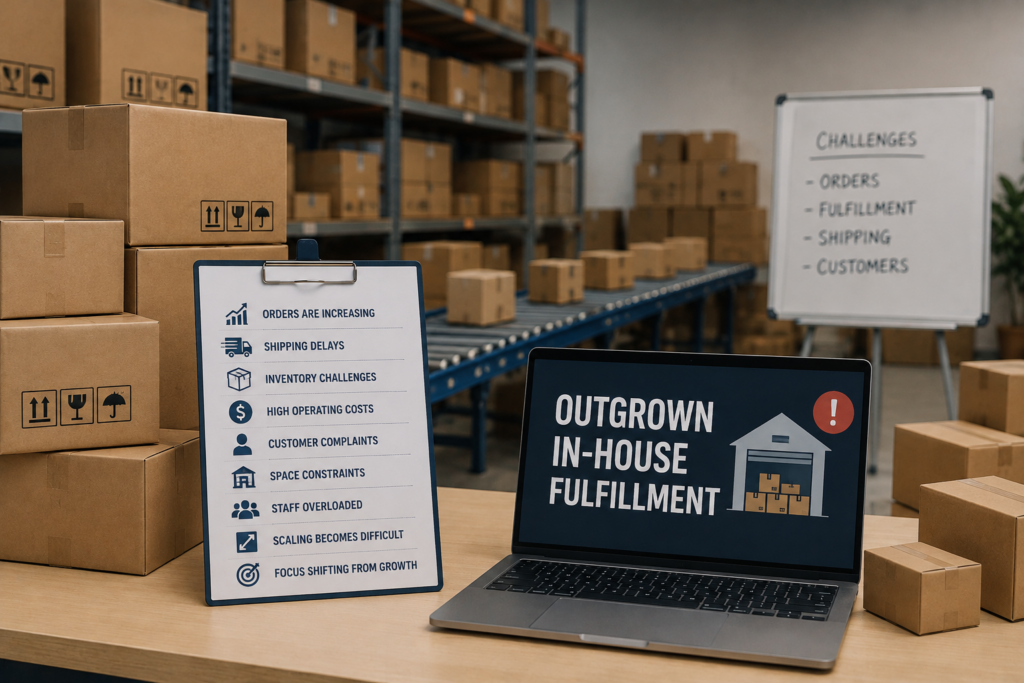
In the early days of an online store, handling orders yourself often makes sense. You can store products in a spare room, pack each order, and manage shipping without a large team. But as sales grow, those same tasks can start taking time away from the work that moves your business forward.
Knowing when to outsource fulfillment can help you avoid delays, rising costs, and unhappy customers. If you spend more time managing inventory and packing boxes than growing your brand, your current setup may no longer be the right fit.
Fulfillment outsourcing allows an outside provider to manage tasks such as storage, picking, packing, and shipping. It can give growing ecommerce brands access to more space, staff, and established processes without building a larger operation from scratch.
Proven Prep helps ecommerce brands explore their fulfillment needs and consider options that support long-term growth. Here are nine signs that your business may be ready for a change.
1. Packing Orders Takes Time Away From Growing Your Business
As a business owner, your time is one of your most valuable resources. You need to plan marketing campaigns, improve product listings, manage suppliers, and build customer relationships. However, these tasks can take a back seat when order fulfillment fills most of your day.
Packing a few orders may seem simple. Yet the work also includes checking inventory, printing labels, finding packaging, arranging shipments, and updating order records. When sales rise, these tasks can become a full-time job.
If you regularly work late to clear the day’s orders, it may be time to review your process. When you outsource ecommerce fulfillment, you can shift much of the daily warehouse work to a dedicated team.
The goal is not to avoid operations altogether. It is to free up time for tasks that help your business grow.
2. Your Order Volume Is Too Much for Your Current Team
A fulfillment process that works for 15 orders a day may struggle when demand reaches 100 or more. The exact limit depends on product size, packing needs, staff capacity, and how orders are organized.
When your team cannot keep up, orders may sit unprocessed or miss carrier pickup times. Hiring more employees can help, but recruitment, training, scheduling, and payroll add more work and cost.
A fulfillment provider may offer the people and systems needed to handle higher order volumes. Before making the switch, ask how it manages busy seasons, sudden sales spikes, and large promotions.
If your team is already working at full capacity, consider whether your current setup can support the next stage of growth.
3. Shipping Delays and Packing Errors Are Increasing
Customers expect to receive the right items within the promised delivery window. When fulfillment becomes rushed, mistakes can become more common. An order may contain the wrong size, a missing item, or packaging that fails to protect the product.
These issues can lead to refunds, replacement shipments, support requests, and negative reviews. They may also reduce the time your team has available for other customer needs.
A professional fulfillment operation may use set picking and packing steps to help reduce errors. Still, service quality varies by provider, so ask about order accuracy, processing times, tracking updates, and how problems are handled.
If shipping complaints are becoming a regular part of your customer service workload, your fulfillment process deserves a closer look.
4. You Are Running Out of Storage Space
Inventory can quickly take over a garage, spare room, office, or small warehouse. As your product range expands, keeping everything organized becomes harder. You may spend more time locating items or struggle to make room for new stock.
Limited space can also affect how you prepare orders. If products are stored in different places or lack clear labels, picking takes longer and errors become more likely.
Warehouse outsourcing may give your business access to organized storage, inventory storage services, and inventory systems without the need to rent and manage a larger facility yourself.
Before choosing a provider, review its storage rates, inventory reporting, receiving process, and rules for slow-moving stock. A suitable setup should make inventory easier to track while leaving room for future growth.
5. Your Fulfillment Costs Keep Rising
Managing orders in-house involves more than paying for postage. Your full costs may include labor, rent, utilities, packaging, shipping tools, equipment, and inventory management software. You should also consider the time spent supervising the process.
These expenses can rise as order volume increases. You may need extra staff during busy periods or more space to store products. Even if each expense seems small, the combined cost can affect your profit margin.
To understand when to outsource fulfillment, calculate your current cost per order. Add up your fulfillment expenses for a set period, then divide that amount by the number of orders shipped.
Next, request quotes from providers and compare the full costs. Include receiving, storage, picking, packing, shipping, and any extra fees. Outsourcing is worth considering when the total cost and service benefits compare well with your current setup.
6. Inventory Tracking Is Becoming Difficult
Accurate inventory records help you avoid selling items that are out of stock. They also help you plan purchases and understand which products are moving quickly.
If your team relies on spreadsheets or manual updates, stock counts may not match the products on your shelves. This can lead to overselling, delayed orders, or unnecessary purchases.
Some fulfillment providers offer systems that connect with ecommerce platforms and update stock levels as orders are processed. These tools can improve visibility, but the features depend on the provider and your store’s setup.
Before you outsource, ask how often inventory records update, whether you can view stock levels, and how the provider handles damaged or missing items. Clear processes matter just as much as the software.
7. Seasonal Sales Put Too Much Pressure on Your Operation
Sales events, holiday shopping, and product launches can bring a sudden rise in orders. While this growth is welcome, it can place heavy pressure on a small fulfillment team.
You may need temporary workers, extra packing supplies, more storage space, and longer work hours. If you cannot prepare for demand in time, orders may ship late and customers may have a poor experience.
Fulfillment outsourcing may help you access an operation built to handle changing order volumes. However, not every provider has unlimited capacity during peak periods.
Ask potential partners about seasonal planning, order cutoffs, storage limits, and peak-season fees. Share your past sales data so they can assess whether their services fit your needs.
8. You Want to Expand Into New Markets or Sales Channels
Selling through more online marketplaces or reaching customers in new regions can create new logistics needs. Different channels may have their own order rules, packaging requirements, and delivery expectations.
Managing every process in-house can become complex, especially if your team already struggles with daily orders. You may need new software, additional staff, or more storage to keep operations running smoothly.
A fulfillment partner may support multiple sales channels or offer access to warehouse locations that suit your customer base. Before committing, confirm that the provider works with your ecommerce platform and can meet your shipping needs.
If expansion is part of your plan, choose a fulfillment model that supports future demand rather than one that only works for today’s order volume.
9. Your Business Is Growing, but Your Processes Have Not Kept Up
Sometimes the clearest sign is that your business has grown faster than your systems. You may have more products, more orders, and more customers, but still rely on manual processes that worked when the store was small.
For example, staff may use separate spreadsheets for stock, orders, and shipping. Updates may depend on one person, and a single mistake can delay several orders. These problems can make growth harder to manage.
A third-party fulfillment provider may offer a more structured process and tools for tracking orders and inventory. It will still require planning, accurate product data, and clear communication from your team.
If daily fulfillment feels harder every month, take time to assess whether your current system can handle the next stage of growth.
How to Decide If Fulfillment Outsourcing Is Worth It
Recognizing the signs is only the first step. Before choosing a provider, review your order volume, product size, storage needs, shipping destinations, and current cost per order.
Then compare providers based on the services they offer. Ask for a clear breakdown of fees, including receiving, storage, picking, packing, shipping, returns, and any account or setup charges. Confirm how inventory is tracked and how order problems are resolved.
You should also review the agreement, service standards, technology integrations, and process for moving your inventory. A low quote may not be the best choice if it leaves out key services or creates extra work for your team.
For brands exploring ecommerce fulfillment services, Proven Prep can be a starting point for reviewing fulfillment requirements and identifying a setup that matches your goals. The right choice should help you manage orders more reliably and give your team more time to focus on growth.
Final Thoughts
Knowing when to outsource fulfillment can help you spot problems before they limit your growth. If packing takes over your schedule, inventory is hard to track, or shipping delays are affecting customers, it may be time to consider a new approach.
Outsourcing is not only about moving boxes to another warehouse. It is about finding a fulfillment process that fits your budget, supports your customers, and leaves your team free to build the business.
Review your costs, assess your current workload, and compare providers carefully. With the right plan and a suitable partner, your ecommerce brand can prepare for growth without letting daily fulfillment become a constant obstacle.
Frequently Asked Questions
1. When should an ecommerce business outsource fulfillment?
Consider outsourcing when order volume exceeds your team’s capacity, storage space becomes limited, shipping errors increase, or fulfillment takes time away from growth. Compare your current costs with provider quotes before deciding.
2. What is outsourced ecommerce fulfillment?
Outsourced ecommerce fulfillment means hiring an outside provider to handle tasks such as inventory storage, picking, packing, and shipping. The exact services depend on the provider and your agreement.
3. Is fulfillment outsourcing cheaper than handling orders in-house?
It can be, but not in every case. Compare labor, rent, supplies, software, shipping, and management time with the provider’s full fees. Your order volume and product needs will affect the result.
4. What is warehouse outsourcing?
Warehouse outsourcing means using an external provider for some or all of your storage and warehouse operations. For ecommerce brands, this may include storing products, tracking inventory, and preparing orders for shipment.
5. Will I lose control over my orders if I use a fulfillment provider?
You will have less direct control over the physical packing process, but you can set service standards and review performance reports. Choose a provider with clear communication, inventory visibility, and reliable support.
6. How do I choose the right fulfillment provider?
Compare pricing, storage options, order processing times, inventory systems, shipping coverage, returns handling, and peak-season capacity. Make sure the provider supports your sales channels and can handle your product requirements.
Proven Prep Center · Portland, Oregon
Ready to hand off your fulfillment?
Tell us what you sell, where you sell it and roughly how many orders you ship. We’ll put together a plan and a quote for your operation. No order minimums for DTC brands.
Or call or text 503-987-8977